Sunday, May 22, 2011
BLOOD LILLIES - The Sign That Summer is over, and Rainy Season Begin
Our farmhand, Danilo points to the lovely red-orange blood lilies.
Some common names for these bulbs include Blood lily, Torch lily, Paintbrush lily, Powderpuff lily, and Fireball lily.
I call them "Powder Puff" Lilies, but their Latin name is :Haemanthus Multiflorus. In some botanical books, these are in the category of Lilies that grow from bulbs like onions. Planted in one spot, they will appear suddenly at the end of summer, after the first deluge of rain falls around the end of May, in the Philippines.
This brilliant, brazen blood lilies are several little, tiny flowers that open together and form a round, delicate powderpuff like ball.
They are a surprise and delight the eyes after a dry, hot summer, these are the sign the monsoon season is at hand.
They have a wide distribution from lowland to mountain forest, but they are very much at home in sun or shade. I placed them in a tiny little "forest" walk near my herbal garden, beside my current empty pond.
They love the sudden moisture of an early rain, but will only shoot up after the rains swell their bulbs with water. Flowers of all species are short‑lived; flower size and coloring differ considerably. After the rains arrive regularly, these will wilt, and then go back to the earth, to rest once more for another year.
Thursday, May 19, 2011
Dendrobiums and Easter Lillies, 2011
I left my dendrobiums in the cooler shade inside my house, near a sunny window in Silang, Cavite. The heat during this summer, 2011 hit 100*F or 35*C and providing the humidity these orchids need, was to water them just before dawn too keep them cool, and let the sun's intensity gradually dry out by noon. The potting materials must dry up before nightfall to avoid any fungus from forming on the leaves.
A few months ago, the group of yellow dendrobiums started to show buds, but I noticed the others that bloomed red I segregated to the side of my house in the semi-shade, were beginning to bloom too.
Quickly, I shifted the position of the orchids to the front porch, and watched them open their buds with the surprise that these plants were naturally pollinated and now had two colors. One group had all yellow, another group had yellow and red petals.
I expected the heat to cause the flowers to dry up and fall off quickly like my oncidiums, that are more delicate , but the yellow and red dendrobiums stayed on for almost 3 weeks!
The Easter Lily popped out of the ground during the Holy Week as scheduled. Nuns at the St. Francis Church at the ridge told me that each year, these lillies will bloom right before Easter Sunday! Sure enough the lillies told me it was definately in time to celebrate Resurrection Sunday.
Monday, April 11, 2011
2011-- Summer Is Here, and the Heat is On!
Summer days in Silang, Cavite are milder than in the lowlands, but I notice each year, the topsoil is becomming very dry. The surrounding urban sprawl, has removed thousands of hectares of forest area. The rivers still run, but the water is now polluted with trash, plastic, and chemical run offs.
My fountain runs continuously, and is always refilled with clean water that is changed every day. The birds, and bees can drink by landing on a rock I placed on the fountain dish so they may drink safely.
Our vegetables are ready for harvest. I don't like using my farm for commercial purposes because it stresses me out to think of business while I am enjoying my time gardening. I grow my own organic produce for my family, and I'd rather give away any surplus to the poorer people around my home than sell it.
The aubergines, cucumbers, lettuce, bak-choy,mongo beans, tomatoes, and carrots are picked in the morning for the daily salad.
We cannot continue planting vegetables without using nets to shade the plants. We use drip hoses to minimize evaporation. Greenhouses are the ideal method to maintaining moisture in the summer and protect the vegetables from storms during the monsoon season.
Certain orchids are blooming, and add to the bright colors of summer!
I don't spray them with hormones, or use fungicides. Some seasons we have lots of flowers in bloom, other seasons, these flowers do not bloom all at the same time.
My kitchen is bright and cheery with all the orchids placed inside to prevent them from drying out once they are in bloom. I don't pamper my orchids.<
I am enjoying seeing the bromeliads thrive in the heat, and my other wood jasmines react to the weather by increasing their scent, to bring pollinators to them even during the hot weather.
Our horse likes taste of our dahlia flowers! I notice that the flower bushes are getting shorter, and now I caught him in the act of chomping my dahlias!
My German Shepherd dog Arwen greets me and wants to romp outside in the heat, but she often gets very thirsty wearing her thick fur in this punishing heat. She is quite an active dog, and raring to start training in agility and obedience.
Thursday, November 4, 2010
Clean Easy and Safely with Lemon, Vinegar and Essential Oils
Organic cleaners are expensive if you buy them at the supermarket or health stores. Now that the economy is tight, there is a cleaner that you can use everywhere, in babies room, your kitchen and bathrooms, counters and pet areas.
A combination of vinegar, pure lemon or local lime juice, and drops of organic essential oils will do the trick. Vinegar is a natural anti-bacterial cleanser. The acid content is from pineapples, fruit or fermented sugars and readily avail of these ingredients.
Going organic and green should not be expensive since all the elements in nature are balanced, and only mankind has become an erratic member of the natural balance. A dose of 100% proof vinegar straight up will kill even fleas and ticks, cockroaches and other insects like bedbugs if these are put in a jar in vinegar. Just 5 percent vinegar kills every single bacteria and germ on the kitchen counter. In fact, when you get a new appliances like coffee maker, blenders, food processors and microwaves, should be cleaned with vinegar and lemon juice for at least 3 times before using it. Vinegar was used in the ancient times as a cleansing agent for wounds, and to disinfect animals before cooking. Vinegar from fruit is the safest, and vinegar from sugar is like using alcohol and will kill 99% of all bacteria, 82% of all molds, and 80% of germs and viruses. Vinegar is safe to use around children and around animal areas. The fact is it marketed as a food should indicate it safe!!
The cleaners we see in the supermarket are bad for our skin and are full of pesticide type chemicals that cause cancer because it interrupts the natural cycle of the metabolism of organisms Soaps and detergents, are full of triclosan-filled antibacterial products that actually can burn your skin if you are sensitive.
Here is the recipe for a "GREEN CLEANSER"
1 spray bottle
1 ½ cups distilled white vinegar
2 cups of water
10-12 drops of your favorite essential oil, i.e. lavender, eucalyptus, jasmine (optional)
Method:
Use a spray bottle and put in all ingredients. Shake well to mix everything up, and always shake before using.
USE the above recipe for some of the following :
*kitchen countertops
*cutting boards
* Inside refrigerator
* disinfect freezer
* bathroom surfaces
TOUGH CLEANSER
Add baking soda with lemon juice, at least 50% of baking soda to 10% vinegar, and you have a good scrub for tough surfaces.
* clean up the water deposits on faucets/shower heads, soak with enough distilled white vinegar to completely cover the fixture with a damp towel or rag and let it soak overnight or eight hours.
GARDEN
* Vinegar is a natural weed killer. Use straight white vinegar (with a high percentage of acetic acid) on grass or weeds and watch them die!
AIR FRESHENER
* Freshen air and remove odors.
* Lemon grass or "Tanglad" or fresh gardenias, or break eucalyptus leaves
soaked in water overnight emit an essential oil that will devour the bad smell of food, and obnoxious smells in the toilet.
Sunday, August 8, 2010
What is Missing? The elusive "Blue Morpho" Butterfly , August 7th, 2010
Blue morpho butterflies are found in the tropical rainforests of Indonesia, and South America. Their numbers have been depleted with the loss of habitat, and because their beauty is so rare, the Japanese collectors pay tribes people and provincial folk to take pupae, or the cocoons, that once matured will turn their occupants into beautiful creatures. These blue morpho butterflies lie at the floor of the rainforest and are camoflaughed because the back of their wings are dark to blend in with the forest, but once they fly upwards, the beating of their wings attract the eyes to the flashing indicacent color of their blue wings.
We have some blue butterflies in Silang too, and I was excited to photograph even one. Blue butterflies are very rare, and they come in all types, from swallowtails, to the common cabbage butterflies. I was delighted to see this tiny local "banded blue butterfly" flying by and landing on my Ixora plant.
One of the most noticeable effects of urban sprawl are the stripping away of the landscape. Bulldozers come in for months to scrape off the top soil, uproot trees, and strip everything in the effort to flatten the grounds to make way for roads and subdivide lots. The immediate change in the climate is apparent, but the signs of a depleted environment are more evident when I realize the experiences I had as a child , can no longer share with my grandsons.
When I was a child, my father would take me out at night to see the fire flies. These are magical insects that glow in the dark and I would catch some and place them in jars so I could look at them more closely, then let them go.
We had this old swing were I could sit across from my Dad and it would be humid right after a rain. I knew nothing about fire flies, but a few tiny specks of light would float by, but the sight became spectacular once my father would request all the lights to be shut off so I could see the glowing little fire flies. The night would be lit with tiny twinkling lights, and I could reach out my hand to touch them, and to play with them as they were attracted to the salt on our sweaty arms.
Another missing element are tiny green frogs, about an inch long, and these would be jumping about during the breaks of the monsoon rains. These tiny frogs lay their eggs with a white foamy mix of their own body fluids in the puddles formed by stagnant water. In just two weeks these tiny frogs are jumping everywhere!
Read More About These Topics:
We have some blue butterflies in Silang too, and I was excited to photograph even one. Blue butterflies are very rare, and they come in all types, from swallowtails, to the common cabbage butterflies. I was delighted to see this tiny local "banded blue butterfly" flying by and landing on my Ixora plant.
![]() |
| The Elusive Banded Blue Butterfly |
![]() |
| The old swing from Loyola Heights where my father and I would sit and watch the fireflies at night. |
We had this old swing were I could sit across from my Dad and it would be humid right after a rain. I knew nothing about fire flies, but a few tiny specks of light would float by, but the sight became spectacular once my father would request all the lights to be shut off so I could see the glowing little fire flies. The night would be lit with tiny twinkling lights, and I could reach out my hand to touch them, and to play with them as they were attracted to the salt on our sweaty arms.
Another missing element are tiny green frogs, about an inch long, and these would be jumping about during the breaks of the monsoon rains. These tiny frogs lay their eggs with a white foamy mix of their own body fluids in the puddles formed by stagnant water. In just two weeks these tiny frogs are jumping everywhere!
![]() |
| One Inch Tiny Frog Is Full Grown |
Wednesday, July 21, 2010
July 17, 2010, Butteflies and Bees are back again!
Collins Butterfly Guide: The Most Complete Guide to the Butterflies of Britain and Europe (Collins Guides)
Butterflies come out once the temperatures reach a high of 85 * F. These flying flowers shield themselves against the rain by hiding under the large leaves and branches of trees. Once the rain stops, they begin to descend on certain flowers and even suck up salt from the wet clay soils on the ground. Each of these butterflies are of different varieties depending on the patterns, background colors and wing shapes.
The photos of the butterflies on this page are just a few that I was able to photograph using a simple Nikon Coolpix camera.
Butterfly are hard to photograph with a simple camera. There is a reward for the patience required to study how these insects behave. I use to follow these flittering little insects while they feed on the blooms in my garden. I try to position myself in the flower garden at different times of the day, but mid morning is the best time to observe butterflies.
Nothing gives me more satisfaction than seeing these butterflies and birds that feast on their larvae. Organic gardening has many benefits, and one of these are the delight in welcoming these winged wonders fluttering about.
Butterflies pollinate flower, and both adults and larvae are an important food source for birds, bats, and other wildlife. Butterflies will lay eggs that will become caterpillars and eat the leaves of the host plant.
Commercial flower farms cannot sell their floral blooms if there are bite marks and tears from caterpillars, so you can be sure that an open air garden is going to have to be free of any pesticides or chemicals if you want these butterflies to propogate. Be sure to avoid the use of insecticides, even the organic kind made with neem tree leaves. You can expect these lovely insects to provide you hours of pleasure admiring the adults, as these butterflies make your garden their breeding and feeding grounds. - and birds, wasps, ladybugs, praying mantis and lacewings will control caterpillars, and other unwanted pests.
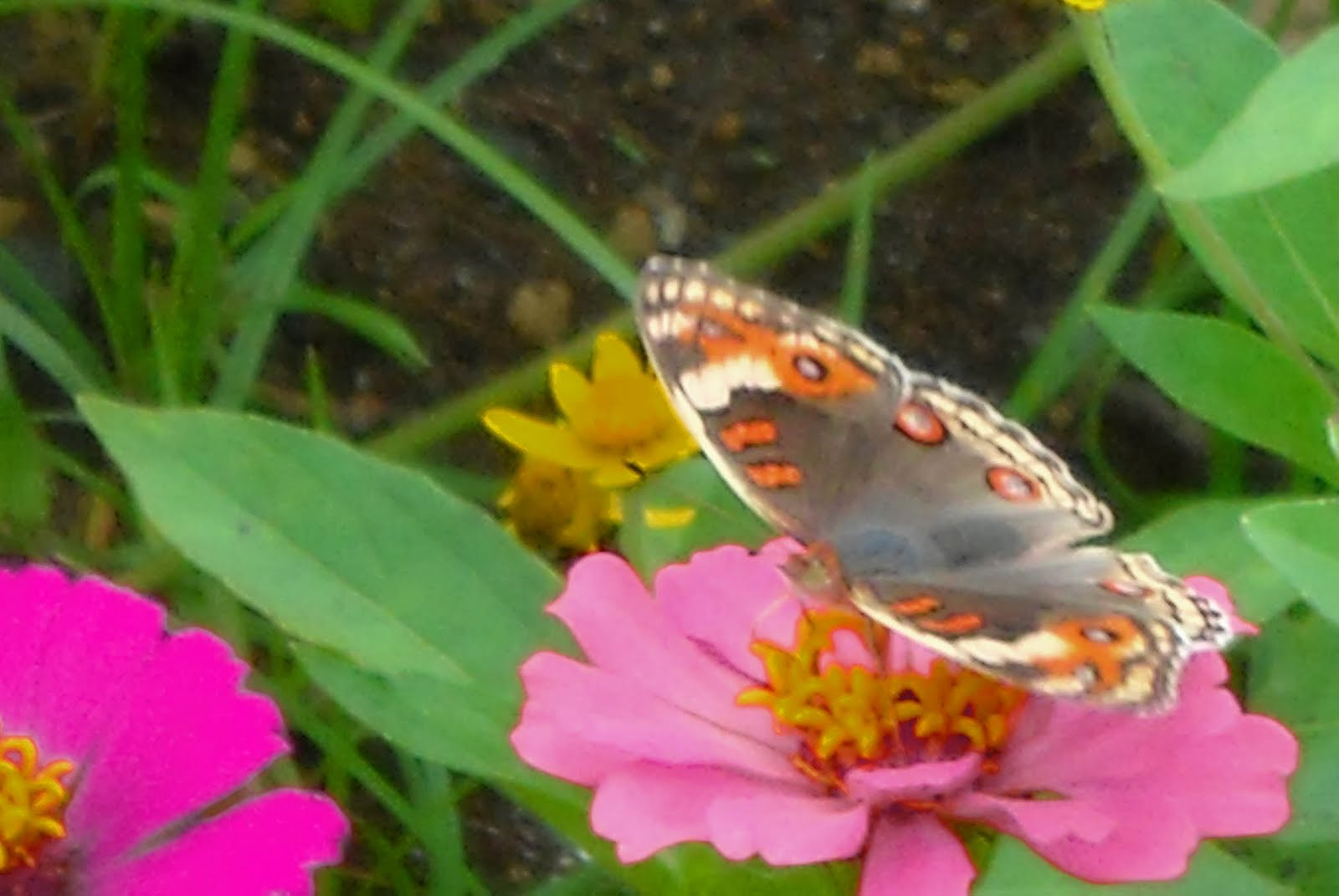
![]() |
| "Painted Lady Butterfly on Red Star Cluster Flowers" |
The photos of the butterflies on this page are just a few that I was able to photograph using a simple Nikon Coolpix camera.
Butterfly are hard to photograph with a simple camera. There is a reward for the patience required to study how these insects behave. I use to follow these flittering little insects while they feed on the blooms in my garden. I try to position myself in the flower garden at different times of the day, but mid morning is the best time to observe butterflies.
Nothing gives me more satisfaction than seeing these butterflies and birds that feast on their larvae. Organic gardening has many benefits, and one of these are the delight in welcoming these winged wonders fluttering about.
Butterflies pollinate flower, and both adults and larvae are an important food source for birds, bats, and other wildlife. Butterflies will lay eggs that will become caterpillars and eat the leaves of the host plant.
Commercial flower farms cannot sell their floral blooms if there are bite marks and tears from caterpillars, so you can be sure that an open air garden is going to have to be free of any pesticides or chemicals if you want these butterflies to propogate. Be sure to avoid the use of insecticides, even the organic kind made with neem tree leaves. You can expect these lovely insects to provide you hours of pleasure admiring the adults, as these butterflies make your garden their breeding and feeding grounds. - and birds, wasps, ladybugs, praying mantis and lacewings will control caterpillars, and other unwanted pests.
![]() |
| "Black Winged Postman Butterfly on Lazy Susan Flowers" |
All my zinnias, star clusters, asters, dahlias, yellow bush, pink periwinkles, impatients are the favorite food of pollinators. Huge bumble bees are often so busy sipping nectar that they are not bothered by me taking their picture.Bees are gorging themselves on nectar of flowers they see are fully open.
Zinnias are the perfect flower to attract them, and have your camera ready, you can't fail to get a shot of these huge, gentle wild bees that join butterflies in gorging on nectar!
Adult butterflies look for sources of nectar for food and color, fragrance, size, and shape are all important characteristics of the best nectar flowers. Because butterflies are nearsighted, they are attracted to large patches of a particular type of flower.
![]() |
| "Yellow and White Sulphur Butterfly on a Zinnia Flower" |
If you want to attract a certain species, a large splash of brightly colored flowers of one type is more effective than several types of different plants. Butterflies will hover and land on blooms from one to the other. If you want to photograph them, stay in one area and focus your camera towards the center of the flower bed. Don't chase the butterflies but trust they will eventually come nearer if you remain still.
However, you can find a wider variety of butterflies when there is rain. After the rain, there are many adult butterflies feeding on the abundant blooms. Planting several kinds of good nectar producing flowers usually attracts more varieties of the species of butterflies common in tropical gardens.
![]() |
| The "Bird Wing" Butterfly |
Fragrance is even more important than color for attracting butterflies. Many nectar producing flowers such as lavender, lilac, and honeysuckle, gives off strong fragrances to attract pollinators. The size and shape of flowers is also important in attracting butterflies for your garden.
Large butterflies, such as the swallowtail, prefer to land on flowers with large compact heads because they provide a seat for the butterflies to rest on while feeding. These types of flowers include asters, goldenrod, zinnia, marigolds, and herb flowers also draw in tiny little butterflies about the size of a fingernail.
Other flower types that butterflies prefer have tightly packed clusters of flowers. These include lantana, honeysuckle, and mildweed. For the best butterfly garden, choose a selection of plants that blossom at different times of the year to provide nectar throughout the rainy and during the dry and sunny seasons. Summer is often very hot in the Philippines, and to keep butterflies coming in to feed, water your flower bed early in the morning to leave little droplets of moisture on the leaves and petals of your flowers.
![]() |
| "Painted Lady Lace Wing Butterfly" |
There have been many sightings of the giant birdswing but these types have become extinct in my region and prefer forests where there are few people.
Cutting down the number of wild meadows, have destroyed habitat of these insects that need a lot of nectar to keep their energy going. They don't live very long, and I think it is cruel to kill a butterfly only to capture its beauty! I would suggest instead of catching them during their breeding season, wait for these creatures to slow down, and they will gently float downwards to the ground and die naturally. If you go around the area where the butterflies are found, you can see a few in perfect condition, quietly still, then pick them up with a gauze cloth, not with your hands because the wings may break off. Gently transfer them onto acid free paper to dry, then pin them in a glass frame.
A scientist from Japan exploring the forests of the Philippines had discovered the giant birdswings in remote areas of the country. These beautiful and colorful butterflies are so prized in the Orient, that hunters are paid $50 to find their chrysallis and export these to Japan where newly married couples release them for good luck during the wedding reception. Bred in captivity, these butterflies often die after just one generation.
![]() |
| "Green Jay Butterfly" |
We all love to watch beautiful, multicolored butterflies flit from flower to flower in our garden, but we hate to see the eaten leaves and partially stripped stems due to feeding caterpillars. But you can't have butterflies without caterpillars!
Flower pecker birds, and fly catcher or bee eaters birds will catch the butterflies in flight. Bee Eater Birds are very colorful too. Sadly, those who own apiaries kill these birds for they feed on honey bees and apiaries lose money if these birds nest near their commercial bee colonies. Bee eaters and fly catchers are the best friends of gardeners, for they will eat any flying insect. I never use pescticides because the healthier your garden is, the more insects like butterflies will want to make it their home. Insects have natural predators in lady bug beetles, preying mantis, birds, lizards and frogs will feast on butterfly caterpillars. In fact, caterpillars provide my free range hens lots of protein!
Thursday, June 17, 2010
Budget Constraints Are Pushing More Women To Plant Their Own Food Gardens!
The demand for organic food is reaching a fever pitch, driving prices sky high at most markets. In these difficult economic times, our household budget has to be shrunk to fit in a lot of requirements for healthier children's lunches and snacks, and to accomodate all kinds of tastes and caprices for food.
At home, I prepare a wide variety of food to suit the tastes of the family. Our menus are never complicated, but we do try to appeal to satisfy the desire for food ranging from ordinary Filipino-Asian food, to gourmet cuisine.
I feel that we are returning to an era where families brought in vegetables, herbs and fruits from their own gardens to be the ingredients of desire for a variety of cuisine. The economic crisis--which is pinching all our budgets--and the shift in values has triggered the most recent collision of people of all classes of society, patronizing the street markets instead of supermarkets. There are the hi-heeled crowd of urbanites, and ordinary housewives who are now shopping at farmers markets at designated areas in certain cities. A few like SM Hypermart supply restaurants with fresh fish, meats and vegetables at wholesale prices.
I for one prefer to search locally produced ingredients for a variety of cuisine that are different from the traditional Filipino food. Goat cheese, fresh rosemary sprigs, hand picked and roasted coffee beans, and cultivated honey from neighborhood apiary contribute to an interesting combination of cuisine we serve at home.
Economic factors are pushing those who live in the cities, to start their own potted herbal gardens at home, or to venture to the rural areas to find a larger tract of land in the countryside to set up a small farm.
Farming in the backyard has put agriculture back in the mainstream. A growing awareness of the methods in starting a small vegetable garden is becomming easy with access to the internet, One can find any subject from raising free range chickens, to planting rice from many websites on these topics.
There is a committed desire for fresh, unpolluted (and unpolluting) organic produce. There is a concern now for the environment with the reality of global warming; the need for alternative sources of energy, and the ever-increasing sophistication of Manila cooks. There are blogs that show the proliferation of self-described "foodies" and the demand for varied, "gourmet" produce. Families are going to nearby agricultural communities to get in contact with mother nature, and to get away from a frantic world.
I am happy to know that everyone is interested in food gardening, and that it should really be a result of a number of the educated population for natural products and organic food.
At home, I prepare a wide variety of food to suit the tastes of the family. Our menus are never complicated, but we do try to appeal to satisfy the desire for food ranging from ordinary Filipino-Asian food, to gourmet cuisine.
I feel that we are returning to an era where families brought in vegetables, herbs and fruits from their own gardens to be the ingredients of desire for a variety of cuisine. The economic crisis--which is pinching all our budgets--and the shift in values has triggered the most recent collision of people of all classes of society, patronizing the street markets instead of supermarkets. There are the hi-heeled crowd of urbanites, and ordinary housewives who are now shopping at farmers markets at designated areas in certain cities. A few like SM Hypermart supply restaurants with fresh fish, meats and vegetables at wholesale prices.
I for one prefer to search locally produced ingredients for a variety of cuisine that are different from the traditional Filipino food. Goat cheese, fresh rosemary sprigs, hand picked and roasted coffee beans, and cultivated honey from neighborhood apiary contribute to an interesting combination of cuisine we serve at home.
Economic factors are pushing those who live in the cities, to start their own potted herbal gardens at home, or to venture to the rural areas to find a larger tract of land in the countryside to set up a small farm.
Farming in the backyard has put agriculture back in the mainstream. A growing awareness of the methods in starting a small vegetable garden is becomming easy with access to the internet, One can find any subject from raising free range chickens, to planting rice from many websites on these topics.
There is a committed desire for fresh, unpolluted (and unpolluting) organic produce. There is a concern now for the environment with the reality of global warming; the need for alternative sources of energy, and the ever-increasing sophistication of Manila cooks. There are blogs that show the proliferation of self-described "foodies" and the demand for varied, "gourmet" produce. Families are going to nearby agricultural communities to get in contact with mother nature, and to get away from a frantic world.
Subscribe to:
Posts (Atom)