I've been staying too long in the city. My lungs hurt from inhaling the foul air, especially during the holidays when fireworks go off for hours after the clock strikes midnight during the New Year celebrations. Metro-Manila's smog was full of dangerous chemicals in fireworks that blended with the regular pollution. It was time for healing and meditation once more at my countryside hideaway in the uplands of Cavite province.
The small place that I own has become a haven for me and even a few of my friends who like spending a few days while they go about their business in the nearby towns. My little house and garden has been neglected for the time being. I notice the need for repairs, and reviving the energy that my husband and I had when we started building the house back in the mid 1990's. Imagine that...it has been 20 years!!! I can still see my daughters running to play with our country ponies...and my first farm dog, Keannu was alive and running about.
We had so much fun, and lots of dreams that seem to fade as each year brought me deeper into the golden years of my life. In fact, those same challenges still exist, but the farm has allowed me to gain back my strength, recover and sometimes heal from many challenges I had to face. I felt the pain of grief as I had to deal with passing of my mother, and then my father...older brother. The farm, with the perpetual renewing of life, helped me appreciate living more than dwelling on the hurt that death brings to those who are left behind.
I miss my father, who always showed interest in organic gardening and helped me understand that the purpose of having a farm is to provide good, nutritious food and herbal medicines to the community. I miss my grandmother and my mother and all her delicious home made food I enjoyed growing up.
I have not been selfish at all, and shared my knowledge and encouraged others who may be interested in improving their life,to grow vegetables and flowering plants around their homes.
I want to live in a country that is proud of the people's efforts to preserve the forests, and protect the watersheds that are vital to all life. I want to wake up to birdsong, and take walks again in parks and safely go about my daily routines without having to own a gas guzzling, maintenance costly, vehicle.

Wednesday, January 4, 2012
Wednesday, December 7, 2011
Should I now learn to make snakeskin leather?
I will discuss one of the problems that is an indicator of the future changes that may happen at my farm as a result of global warming. I am now host to the wildlife that has decided to move nearer to the urban community that has invaded my quiet haven in the town of Silang.
At my farm, wildlife are now turning up in the wrong places. This may seem trivial to most people who will claim it is a normal thing to find snakes in the gardens in the tropics. I think it is not abnormal to find snakes, but not dozens of 15 foot pythons in the area where I have my farm.
For the first time, the annual deluge has brought me some very large pythons that are showing up very hungry! These larger pythons are showing up on my farm more and more frequently, and all I can think about is, whether or not this is a normal or strange effect of the 2o years of subdivision development upland?

The pythons are attracted by my free range chickens, they have been hunting and foraging nearer and nearer to our area, and now finally have invaded my farm. These large pythons come over during the rainy season,carried by the floodwater from the higher elevation that was once full of coconut and fruit orchards. In the past, it was a normal thing that we lose a few chickens, but mainly the younger ones that don't come in at night. We only feed our free range chickens in the late afternoon, and bring them inside the barn area where they safely nest at night.

These large serpents coming in have changed everything. We are now catching them coming in through drains, and through the roofs, and killing more than 5 chickens at a time. They can get part of their bodies into the shed by breaking down portions of the screen with their heads, then killing the chickens by crushing them in their powerful embrace, but they cannot swallow and leave with their bellies full. In fact, one very large python got into the chicken coop, swallowed three chickens then regugurated them back because it could not squeeze back through the opening it made before the sun came out for a new day. There was the large python lying with dead chickens beside it, and it was cowering in a corner, a massive coiled serpent. How does one wrangle with a massive male python? We are sorry to say, it was necessary to kill it, than for our farm hands to lose a limb and or their lives in trying to catch them.
This is what a dead chicken crushed by a python looks like. This chicken belonged to another farmer. I just pitied the chicken to see it like that. The chicken in this picture, had every bone crushed by a 10 foot python.

My chickens are not tied, and they can run if they see a snake, but a sleeping hen has no chance to get away from a big python that has fish-hook type teeth and bone crushing force to squeeze it to death.
A few female pythons we caught on our farm were smaller, about 9-11 feet in length. I personally found a big one that took refuge under the overgrown plants near my horse stable. The snake couldn't hide for very long since the color of the one we caught was a beautiful yellow and ochre color.
When we roam around our property, we now have to check for snakes before they find us. I am careful because some snakes that may be poisonous try to catch geckos and can wander their way into our house.
Boa constrictors give birth to live young, and will find a spot that is away from people, whereas pythons lay eggs in nests of mud and grass, and tend to be very bold about moving into property that has a ready food supply.
Our poultry farm is near the river. Boas prefer to stay in trees waiting to lurk around sleeping birds at night, or sleepy bats during the day. Pythons like to make their way up sewage pipes and big drains to get into an underground tunnel where they will sleep for weeks until hunger wakes them up. Pythons will then start to hunt by using their heat pits to locate prey. They are very effective during the darker days of the rainy season and it is often when they are sighted slithering away with a big belly, and desperate to get back into their tunnels and holes after feeding.
This large python was killed by a security guard in another poultry farm in Batangas. The guard shot in the head after it was caught inside the barn after eating 4 chickens. The python regurgurated the chickens and tried to flee but there would be no way to catch a 15 foot python without being seriously injured.

Pythons also feed on anything they can catch. Their favorite food are birds and bats, and when orchards are cut, a lot of these pythons that roost in trees or caves eating bats, and birds will be very hungry and start looking for prey in poultry farms, or homes where there may be small mammals like rats.
I used to catch and release the pythons far in the neighboring area of Indang, or Amadeo, but I realize these pythons can lay as much as 80 eggs that will populate the countryside at an alarming rate if these are not managed somehow. Pythons usually forage during the early morning or late afternoon, or on moonlit nights. They usually eat birds, rats, small mammals, lizards and of course the occassional feral chicken, dog or cat.
We have caught at least a dozen large pythons this year. We used to rarely catch one over 4 feet, but now these serpents are showing up looking like they are big enough to eat an entire goat.
I wonder if I should shift from raising free range chicken to raising free range pythons for leather?
The few we caught were given over to the natives to eat. They value the meat as tasting like chicken !! well, of course...they ate my chickens! Now they are eaten...karma..


Why I haven't posted anything for months...
I have been avoiding expressing my anger at my surroundings because quite frankly, I cannot do anything about what is happening. Global warming is affecting us all, but it is very true that majority of people, including me are just shrugging and saying " What can we do anyway?"
I feel like screaming sometimes because WE CAN DO SOMETHING...as inhabitants of this province of Cavite, there is a bunch of leaders who are just not getting it!
Rain is now pouring down, and out of control because the natural balance was destroyed when millions of rainforest, and orchard land was cut to make way for these land developers to create an upland suburbia.
The watersheds were sold off by the thousands of hectares, and because bulldozers have uprooted all the trees to create those soft, rolling hills that can be subdivided as lots to sell to people, there is nothing to hold the earth from washing out with the rainwater. What happens after the rains stop, is silt depositing on the land, raising the level of the river. Succeeding years of heavy rain, will further erode the uplands until huge breaks in the surrounding banks of the river will also wash away.
This balance has been tampered with. When the rivers are overflowing, and there is NO MORE WATERSHED, certain adverse changes will happen! The river is rising and bringing all kinds of problems. All this water once was stored in acquifers in the upland region, and in the roots of forest trees in the watershed. Watersheds are set aside as forested areas that should be left untouched to prevent rainwater from eroding the soil. All this mud and water then pours down into the lowlands and becomes a flood, and mud landslides can kill people living in the lower areas.
The rain, and outpouring of the river into the lowlands was a normal process that fertilized rice paddies, and gave us many centuries of abundant harvests. The rice fields, and estuaries benefited from the rivers swelling and depositing rich minerals and silt that diluted estuaries salty brine, giving us a new generation of fish fry from spawning ocean varieties that come to lay eggs in that silt.
The river that blessed the lowlands, is now the factor that is destructive, instead of productive. What used to be a normal circumstance, and a beneficial relationship between water, earth and sea, is now instruments of disaster.
I have to post certain events that have convinced me that maybe I need to migrate to another country with strict zoning laws, and policies that protect the land. We who are organic farmers want to flee from these agents of commercial agriculture and get away from areas where they are spraying pesticides, and the using GMO seeds!
I got ridiculed and dismissed by many who believe everything is for the good of the nation. WHAT? Spraying poison, and dumping chemicals in rivers, having garbage in the streams, cutting down rainforests for stupid urbanites to have a rest house in the uplands they use like once a month, is good for the nation?? Excuse me, I am no longer enthusiastic about the area as I was when I first got here.
I dread the thought of leaving the province and stay in the polluted city until I am paralyzed with fear of going out for a walk to inhale poison in the air...
There are more urban housing projects to come..and I can't remain in this area and suffer the effects of watching the beautiful scenery of coconut plantations, mango orchards, and narra forest land end up as the sight of the rooftops, and traffic jams of a rising urban community at my doorstep. Staying and looking around at condos in the middle of what once was beautiful grazing land is painful.
After writing this blog to let off steam, I decided to write leaders of this nation and also try to post facebook messages, send emails to people, and a lot of successful business people. They can influence the leadership, and both business people male and female alike. However, progress, and the increase in revenue for the city blinds the politicians to the simple beauty of their countryside. Every single provincial government wants a big city and that is sad. This area is not suitable for the kind of pollution, density of population that comes with the city style. Poverty will only spread when more people crowd in, using up more resources than the area can provide. What is the simple answer to the question on how to end poverty in the Philippines? The answer given to me is " go abroad!!."
I wonder if there are some who care enough to go out and convince people to vote for strict agriculture zoning in CALABARZON. What I was told was, it is okay for me to continue to keep my farm, and it would even be a novelty because a lot of city folk are moving to Silang, Cavite to enjoy the weather, and it is about time I started putting up a restaurant or some business dealing in organics!
My principles are not for sale. One CANNOT HAVE AN ORGANIC POULTRY FARM in the middle of a metropolis. The free range chickens will pick up filth and debris, making them unhealthy carriers of disease, and the pollution from vehicles using lead in the gasoline or diesel will corrupt the air. Plants do absorb lead, and other toxic elements...so do animals absorb pollutants, and toxic substances in their blood! I do not know how people who graduate from college do not understand this? Sure, one can have an organic garden and grow vegetables in their backyard..but in a city that is polluted, one has to be very, very careful about going about it!
I was told to be happy there is progress in our town. Here is what I see is the result of that "progress" beside the creek near my farm. The amount of garbage is increasing every day. Is this progress?

Saturday, June 25, 2011
PASSION FRUIT CAN CURE CANCER AND MANY OTHER AILMENTS!
My passion fruit vines are full of unripen green fruit. In a week, I expect more ripen fruit to harvest. Passion fruit is being studied by many medical laboratories to learn how it can cure serious ailments like cancer.
Passion Fruit has Phytochemicals that is a powerful anti-toxicant. These phytochemicals are called :Passaflorine, Harmine, Harman, Harmol, Harmalin, Carotenoids, Vitexin, Isovitexin and Chrysin, Scopoletin, Carotenoids, Theobromine
The juice, but mainly the leaves of passion fruit contain the alkaloids, including Harman, which has blood pressure lowering, sedative and antispasmodic action. The passion fruit leaves are used in many countries as medicines for a variety of illnesses, but the latest find is that passion fruit juice can kill cancer cells in vitro.
The flower of passion fruit has a mild sedative and can help to induce sleep which is good for insomniacs.

Passion flower has also been used in the treatment of nervous disorders, epilepsy and hyperactive children, bronchial asthma, insomnia, nervous gastrointestinal disorders and menopausal problems.
Passion flower however was sometimes used as a mild hallucinogen by native Caribbean natives, similar to marijuana. The Caribbean natives would drink a tea made from the leaves of the passion fruit, and go into a trance to speak to their ancestral spirits. This practice was stopped after the Spanish conquered them, and converted them to Catholicism.
There is a study done in the USA, that studied the effect of fruit juices on those who have cancer. The results proved that yellow passion fruit extracts can kill cancer cells in vitro. The phytochemicals which are responsible for this anti-cancer effect are carotenoids and polyphenols.
The variety of passion fruit we have in the Philippines is the yellow one. The Spanish brought in the passion fruit vines of yellow passion fruit to the Philippines. The purple passion fruit grows in Central and South America, and the peel extract can reduce asthma symptoms. Another study focused on 42 asthmatic patients and gave them an oral administration of purple passion fruit extract. The passion fruit extract supplementation reduced the wheezing by 75 percent and increased forced vital capacity.
Passion fruit peel extract also cures knee osteoarthritis. Medical doctors did a study on patients suffering from arthritis. The results was that it was discovered that the flavanoid rich extract significantly reduced pain and stiffness.
Spanish priests who arrived with the explorers that eventually conquered Central and South America discovered native medicine men using this passion fruit as medicine. The passion fruit juice made people relaxed and sleepy. The leaves were made into a tea, and used as a sleep-inducing medicine. The name 'Passion' was given by Catholic missionaries in South America. The corona threads of the passion flower were seen as a symbol of the crown of thorns, the five stamens for wounds, the five petals and five sepals as the ten apostles (excluding the two that betrayed Jesus, namely Judas and later Peter who denied knowing Jesus after the arrest of Jesus at the garden of Gesethame) and the three stigmas for the nails on the cross.

How to make passion fruit juice:
Take the yellow ripen passion fruit.
*Cut in half
*Scoop out seeds and pulp around seeds.

Add 1 tablespoon sugar for every 1 passion fruit (two sides = 1 fruit) and then mix with the seeds/pulp extracted. Add 1 cup per fruit, and mix well. This juice can be mixed with pineapple juice or guava juice too.

Use pineapple juice instead of water…add sugar to seeds like making simple passion fruit juice, but the pineapple juice is already sweet. Just mix to taste! ENJOY with cool ice cubs and a bit of mint leaf!
Drain off seeds (for replanting…just place in fertile soil, and wait till vine sprouts).
Thursday, June 23, 2011
SNAKES IN THE GRASS -- JUNE 2011
I usually take a walk-about my farm to check on every single area. My walk will start from the main house garden, to the flower beds along the center pathway, to open field, checking drains, and looking out for the animals.
Many years ago, I learned to speak “duck” and observed the quiet attitude of my poultry whenever a storm, or monsoon rain was about to start. Usually, the chickens are everywhere, making their sweet clucking sounds as they forage through the grass and bushes. The ducks are often very playful once the rains soak the grounds, bringing a new generation of water snails which is their favorite food. I know the ducks have been out, by the number of snail shells I see empty, devoid of their luscious content. I don’t eat edible snails, or any kind of mollusk, even clams. Ducks are always wagging their tails, and quacking at each other, except when they know something dangerous lurks nearby.
This code of silence is clearly noticeable. I’ve never failed to enjoy an enthusiasm among the birds when there are breaks in the rain. When I walk around, I am welcomed by the shrieks of happy kingfishers, and the loud chirps of Malaysian Fantails hopping from the fountain where they bathe and drink, to the delicate quips of the nectar birds.
However, there was nothing but stone, cold, silence. I knew right away, this stillness meant there was a large snake somewhere. The ducks, chickens, even the birds of the sky see it, but I don’t. Suspicious, I ask our farm hand, Buhat to walk around the farm with me, and where there is an over abundance of weeds, and a plant I call “Corazon de Jesus,” I know that section of the farm has been unattended to.
Almost immediately, I saw the large elephant like ears of the “Corazon de Jesus” plant, which has a pink, heart shaped design in different sizes. The biggest leaves were against the wall, and it is very evident, the area beside the coffee bushes, lanzones, and “Dona Imelda” bushes, with their pink leaves, was overgrown. I had to have these plants cut back.
Buhat and I broke off some tall, red colored Ti plants to spread around the farm. I love their flame colored leaves, and I asked that these broken off stems be inserted in that area I wanted cleared of the “Corazon de Jesus “plant. This plant got its name from my Lola’s banishing this swamp plant because it attracts snakes. Snakes somehow like to coil themselves around it and just enjoy the coolness of the puddles of water during hot humid days. Sure enough, Buhat leaped back as he was just about to plunge a red Ti plant stem into the ground.

He saw a huge snake. He told me not to come near, as it was a large, and very bright colored snake. Buhat called for another farm hand to bring a long pole and help him catch the snake. When I heard “catch the snake,” in the vernacular, I knew it was not poisonous. I ran to the house to get my camera. I handed the camera to Esko and asked him to take photos because I did not want any large snake to chase me.

As soon as Esko made his way to the bushes, Soling leaped on the fence and started to scream. She said it was a huge snake, and it was hissing and opening its mouth, threatening the men.

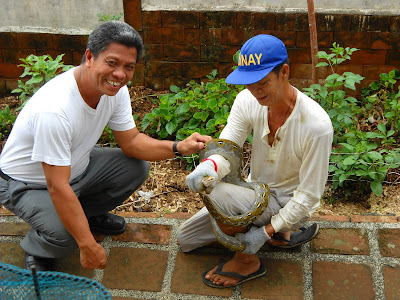
Buhat was able to catch the snake, and I knew from the beautiful patterns, it was a boa constrictor. Buhat said the bigger male was caught a few weeks ago, and this smaller 7 footer must be the female.
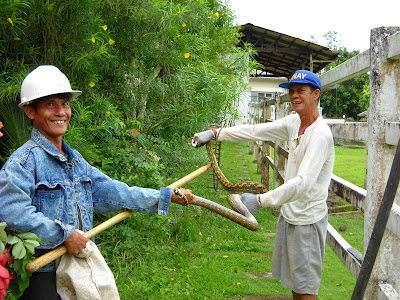
Boa constrictors are quite colorful. The difference between pythons and boa constrictors is that pythons lay eggs, and boas give birth to live young. I’ve never seen boas that are as colorful as this one that my farm hands caught. The snake had patterns with gray, black, white and gold markings. I marveled at the beauty of something that could easily kill a large chicken, and probably helped her to a few of my pullets, wandering around foraging for food. This is one of the risks of having free range chickens running around the farm, especially during the rainy season where these snakes, stalk the smaller chickens, sleeping birds, and climb trees to catch bats eating ripening fruits at night.

The snake was set free many kilometers away, in another area. I wonder if this beautiful, bright colored snake would continue to evade people. A few exotic Chinese restaurants have been cashing in the latest craze of gecko napping going on, and the chefs at these oriental kitchens often serve snake, especially during the rainy season.
I immediately heard the noisy ducks clamor for their chance at playing in the rain, and the birds once again filled the sky with their joyful song.
Till the next snake hunt, hopefully not in the near future…I will avoid walking around the farm most especially just in slippers. Never go barefooted in wet grassy lawns. You never know what may be lurking about during the monsoon season!
Many years ago, I learned to speak “duck” and observed the quiet attitude of my poultry whenever a storm, or monsoon rain was about to start. Usually, the chickens are everywhere, making their sweet clucking sounds as they forage through the grass and bushes. The ducks are often very playful once the rains soak the grounds, bringing a new generation of water snails which is their favorite food. I know the ducks have been out, by the number of snail shells I see empty, devoid of their luscious content. I don’t eat edible snails, or any kind of mollusk, even clams. Ducks are always wagging their tails, and quacking at each other, except when they know something dangerous lurks nearby.
This code of silence is clearly noticeable. I’ve never failed to enjoy an enthusiasm among the birds when there are breaks in the rain. When I walk around, I am welcomed by the shrieks of happy kingfishers, and the loud chirps of Malaysian Fantails hopping from the fountain where they bathe and drink, to the delicate quips of the nectar birds.
However, there was nothing but stone, cold, silence. I knew right away, this stillness meant there was a large snake somewhere. The ducks, chickens, even the birds of the sky see it, but I don’t. Suspicious, I ask our farm hand, Buhat to walk around the farm with me, and where there is an over abundance of weeds, and a plant I call “Corazon de Jesus,” I know that section of the farm has been unattended to.
Almost immediately, I saw the large elephant like ears of the “Corazon de Jesus” plant, which has a pink, heart shaped design in different sizes. The biggest leaves were against the wall, and it is very evident, the area beside the coffee bushes, lanzones, and “Dona Imelda” bushes, with their pink leaves, was overgrown. I had to have these plants cut back.
Buhat and I broke off some tall, red colored Ti plants to spread around the farm. I love their flame colored leaves, and I asked that these broken off stems be inserted in that area I wanted cleared of the “Corazon de Jesus “plant. This plant got its name from my Lola’s banishing this swamp plant because it attracts snakes. Snakes somehow like to coil themselves around it and just enjoy the coolness of the puddles of water during hot humid days. Sure enough, Buhat leaped back as he was just about to plunge a red Ti plant stem into the ground.

He saw a huge snake. He told me not to come near, as it was a large, and very bright colored snake. Buhat called for another farm hand to bring a long pole and help him catch the snake. When I heard “catch the snake,” in the vernacular, I knew it was not poisonous. I ran to the house to get my camera. I handed the camera to Esko and asked him to take photos because I did not want any large snake to chase me.

As soon as Esko made his way to the bushes, Soling leaped on the fence and started to scream. She said it was a huge snake, and it was hissing and opening its mouth, threatening the men.

Buhat was able to catch the snake, and I knew from the beautiful patterns, it was a boa constrictor. Buhat said the bigger male was caught a few weeks ago, and this smaller 7 footer must be the female.

Boa constrictors are quite colorful. The difference between pythons and boa constrictors is that pythons lay eggs, and boas give birth to live young. I’ve never seen boas that are as colorful as this one that my farm hands caught. The snake had patterns with gray, black, white and gold markings. I marveled at the beauty of something that could easily kill a large chicken, and probably helped her to a few of my pullets, wandering around foraging for food. This is one of the risks of having free range chickens running around the farm, especially during the rainy season where these snakes, stalk the smaller chickens, sleeping birds, and climb trees to catch bats eating ripening fruits at night.

The snake was set free many kilometers away, in another area. I wonder if this beautiful, bright colored snake would continue to evade people. A few exotic Chinese restaurants have been cashing in the latest craze of gecko napping going on, and the chefs at these oriental kitchens often serve snake, especially during the rainy season.

I immediately heard the noisy ducks clamor for their chance at playing in the rain, and the birds once again filled the sky with their joyful song.
Till the next snake hunt, hopefully not in the near future…I will avoid walking around the farm most especially just in slippers. Never go barefooted in wet grassy lawns. You never know what may be lurking about during the monsoon season!
Tuesday, June 7, 2011
A Walk In The Grasslands of Cavite, Philippines

June is the first month of the monsoon season. A week has passed since the announcement of a major typhoon named "Chedeng," was headed for the Tagalog region where Cavite is located. The storm brought some coolness, and lots of rain, but right after "Chedeng" exited the Philippines, and headed for Taiwan, the heat went back up to about 39*C. This heat, is joined by an intense humidity, that feels like my blood is being pumped out of my body. The sweat falls down my face like large wet beads, soaking my shirt, and pants as if someone doused me with warm water. Even at high noon when the sun is right above, the heat combines with the extreme humidity, to form a steam. The air feels like I am standing above a rice cooker. The earth gives out an odor, which locals call "singaw ng lupa" in Tagalog. This is an intense evaporation of the superficial water from the ground, that is softened after soaking from previous rains.
Silang is located at the foothills near the highlands of Tagaytay Ridge. At the highest point, one can see the peak where Imelda Marcos built a "palace-in-the-sky" with a 360 degree sweeping view of Taal Lake, Laguna de Bay, Balayan Bay, and the skyscrapers of Metro-Manila.
Walking around noontime, the humidity from these hilltops is not as severe as down in city of Metro Manila. I could bear the heat and the humidity as I strolled up and down a small biker's pathway to see the 100 hectares of grazing land. A gentle breeze flowed ever so slightly, and the expanse of green grass before me, is a feast for tired eyes.

I love animals, and feel bad that these very happy, contended cows will someday end up in the meat markets. I really wondered what happened to the Magnolia Dairy Farm that during my youth produced the best, fresh milk, and cheese found in Metro-Manila. Asian people are not found of milk or cheese. Perhaps Filipinos are highly lactose intolerant, and prefer meat to milk, but the grasslands in this area are plentiful and rich. I am sure if more of these pastures are kept for the grazing of cows, the country will not have to import milk powder, or frozen fresh milk, butter or cheese. There is plenty of land here. If a foundation could be set up to buy this land, the community of farmers in this province can form a coop, and start a dairy farm within this same area. Otherwise, the land will end up as housing projects.

There are several dozens of newly born calves and baby goats playing and grazing near their mothers. The mother cows and goat's udders were loaded with milk.

These goats and cows were full of milk. Imagine that the Philippines imports milk powder from China, New Zealand and Australia, and right here in this pasture, there are many lactating females. No one seems to care to make use of all their converted nutrients from these luscious, green grasses. The land is still unpolluted because the grazing animals have lots of room to move around. The ratio that would be suitable is to space the cows, about 1 cow per hectare. In 100 hectares, 10 cows, and 2 bulls would quickly multiply to about 100 head in a few seasons. This land is way up on the foothills of Cavite, right before Tagaytay. The weather is much cooler, and the ground cleaner. I did not feel stress to walk around the property.

In the distance, I noticed a few urban housing projects going up. Unfortunately, I was told, this beautiful grassland would eventually be developed into another subdivision. I enjoyed this day, for as the Philippine real estate market predicts an increase in demand for middle class houses, there is little time before more of the beautiful pastures of Silang, Cavite countryside will be gone. In just a few years, this peaceful setting of tranquil cows and goats feeding on a carpet of green, will end up once more, as part of the urban sprawl.
Sunday, May 22, 2011
Mango Fever Sets In The Month of May, 2011

May is the month of mangoes. We are all waiting for these green mangoes to ripen.
The idea of picking mangoes myself from my farm was always a vision I had as a little girl. Mangos are my favorite fruits. Filipinos everywhere pride themselves in having the sweetest and most juicy mangoes on earth!
Here are my mangoes still on the tree, right in my driveway at my farm.

Mango Trees are actually equipped with their own self defense. Mango leaves and stems have a poisonous , sticky, white sap that insects do not like. There may be a lot of ants on the tree, but they do not mess with this sap. Birds, and other insects stay away, or merely sit and wait for the mangoes to ripen. That is when everyone races to get to the fruit.

We plant a lot of flowers around the fruit trees to encourage pollinators like bumble bees, honey bees, butterflies to come and do their job in spreading the pollen of the flowers.
Fertilized naturally by these natural pollinators, we do not spray our trees at all with any enhancement chemicals, bloomers, or insecticides.
Bats, birds, insects will then taste the fruit, and once this milky sap turns to sweetness, the mangoes will allow the fruit to be eaten and the seed to drop to the ground and begin a new generation.
We can only eat some of this queen of tropical fruits, but the rest of the fruits will become jams, juice, toppings for cakes, and just enjoyed right off the tree for a wonderful treat!

Subscribe to:
Posts (Atom)